


Imagine a Tuesday on Court Square: orders ping, cloud apps hum, and your gigabit business internet in Newnan can’t hiccup. When it does, revenue stops. The upside? Newnan now enjoys metro-grade bandwidth. AT&T’s fiber touches 87 percent of addresses at up to 5 Gbps symmetrical, cable rivals have upgraded DOCSIS, and 5G newcomers add no-contract backup. Translation: you have choices—but not every “gigabit” plan is equal.
We mined FCC maps, promo fine print, and street-level reviews to rank the seven best providers for 2026. Ready to see the scorecard and choose with confidence? Let’s plug in.
How we chose the winners
To pick a clear leader, we scored every gig-capable provider in Newnan against five criteria you care about.
Performance comes first. A gigabit label matters only if the line delivers steady speed and single-digit latency when your team uploads design files or streams training videos.
Reliability follows. Downtime hurts revenue, so we consider published uptime targets, network technology, and recent outage reports. Fiber promising a 99.9 percent service goal naturally ranks higher than best-effort cable.
WOW! Business publishes that same 99.9 percent reliability figure for its standard Business Internet plans and pairs it with 24/7 U.S.-based support.
Those public benchmarks make it easy to vet their SLA against rivals before you pick up the phone.
Next is value. We log the street price for a 1 Gbps plan, note price-lock guarantees, and add in hidden fees for static IPs or extra hardware.
Support sits fourth. Local technicians and 24/7 business help lines earn points, while long phone trees or offshore hand-offs lose them.
Finally, we award credit for useful extras such as built-in LTE failover, managed Wi-Fi, or contract buyouts because those perks remove headaches you would otherwise pay to solve.
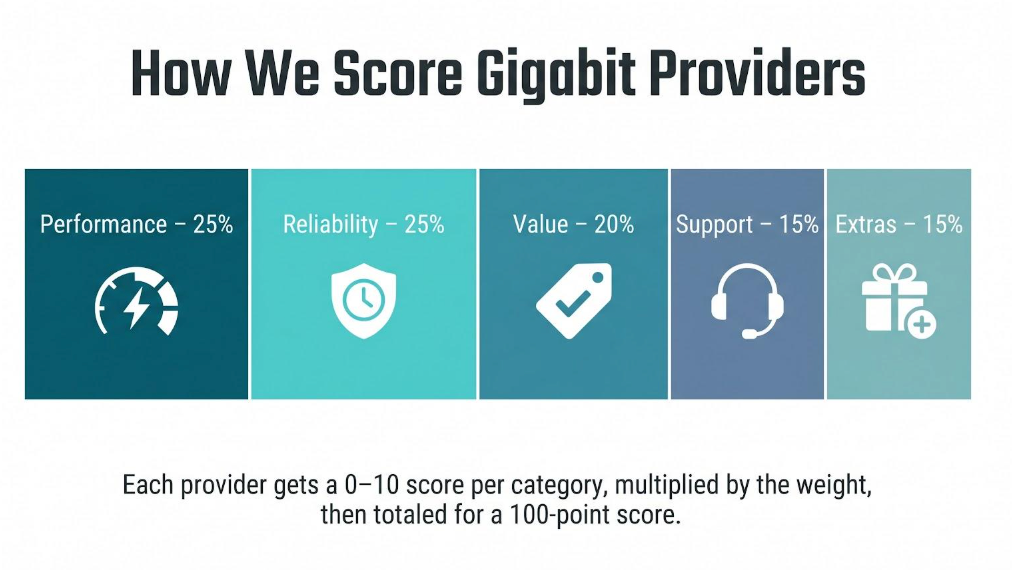
Weights mirror real-world priorities: speed and reliability at 25 percent each, value at 20 percent, support at 15 percent, and extras at 15 percent. Each provider receives a zero-to-ten score in every bucket that is multiplied by the weight, then totaled for a clean 100-point score.
This transparent rubric shows why a hometown favorite or a 5G challenger lands where it does and helps you focus on the metrics that matter most to your business.
Gigabit options at a glance
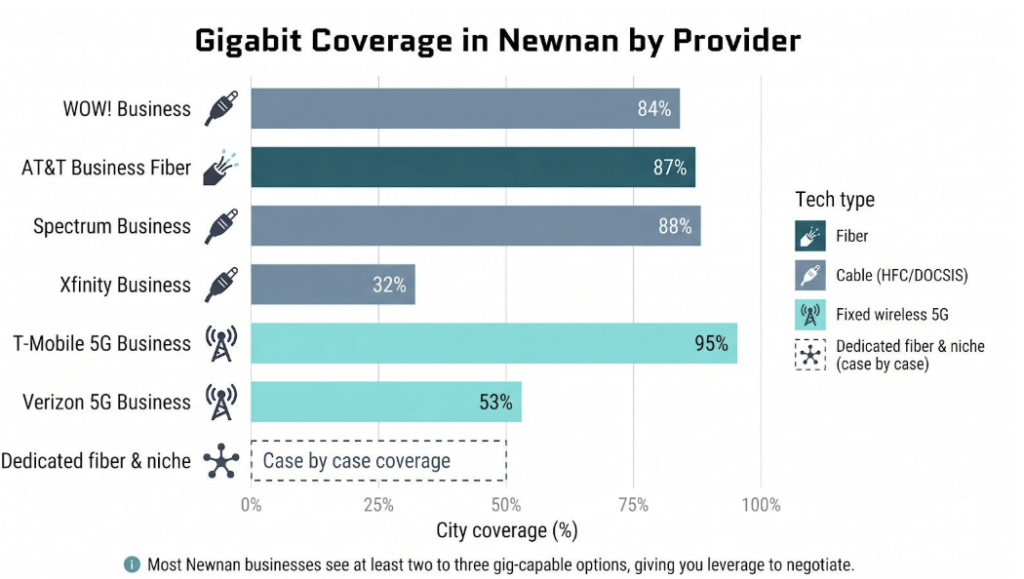
Before we dive into the details for each provider, it helps to see the field side by side. Think of this table as the quick reference you sketch before calling sales reps.
| Provider | Tech | Max down / up | Typical 1 Gbps price* | Contract | City coverage |
| WOW! Business | Cable (HFC) | 1.2 Gbps / 50 Mbps | about $76 / mo with 12-month price lock | 1–3 yrs for best rate | 84% |
| AT&T Business Fiber | Fiber | 1–5 Gbps / symmetrical | about $140 / mo for 1 Gbps | 1-yr optional | 87% |
| Spectrum Business | Cable | 1 Gbps / 35 Mbps | about $249 / mo | none required | 88% |
| Xfinity Business | Cable (DOCSIS 3.1) | 1.2 Gbps / 35–100 Mbps | about $200 / mo on 2-yr | 2 yrs | 32% |
| T-Mobile 5G Business | Fixed wireless | ~100 Mbps / 20 Mbps | $50 / mo | none | 95% |
| Verizon 5G Business | Fixed wireless | 100–300 Mbps / 20 Mbps | $69–$199 / mo | 1–2 yrs optional | 53% |
| Dedicated fiber & niche | Fiber or microwave | 1–10 Gbps / symmetrical | $1,000+ / mo | 3 yrs typical | case by case |
*Prices are ballpark street rates for standard 1 Gbps tiers before equipment, taxes, or promo credits. Always request a formal quote for your exact address.
Scan the coverage column and you will notice Newnan’s rare perk: almost every business sits within reach of at least two gig-speed networks, and many downtown blocks see three. That overlap gives you leverage when it is time to negotiate.
With the lay of the land clear, let’s examine each contender, starting with the hometown provider that keeps its promises and your price steady.
1. WOW! Business – best local cable value
Pair that with free installation and three months of service credit, and the cost per megabit undercuts most national brands before you even start negotiating.
The provider also throws in free installation, and right now its Newnan, GA business internet page touts an extra three months of service at no charge for plans 300 Mbps and up, so the cost per megabit undercuts most national brands before you even start negotiating.
Snapshot: hometown speed without sticker shock
WOW! bought the Newnan Utilities network in the 1990s, so its coax lines blanket almost every street and strip mall. Today the company delivers 1.2 Gbps down and 50 Mbps up to about 84 percent of business addresses.
That footprint matters. When a tech rolls up to troubleshoot, she drives five minutes from the Sewell Road hub, not an hour from Atlanta. Local crews cut repair windows and keep hold times short because the support team knows Coweta County by heart.
On price, WOW! plays the long game. A 12- or 36-month term keeps the bill around $76 per month for the entire agreement, with no second-year jump. Pair that with free installation and three months of service credit, and the cost per megabit undercuts most national brands before you even start negotiating.
2. AT&T Business Fiber – best for symmetrical speed and uptime
AT&T has spent the last few years stringing fiber through Newnan. The result: roughly 87 percent of addresses now sit within reach of gig lines, and many can upgrade to 2 Gbps or even 5 Gbps. For almost any storefront, real fiber is waiting at the curb.
The first payoff is symmetry. Uploads move as fast as downloads, so cloud backups wrap up before lunch, designers push large media files without throttling, and video calls stay crisp even when the whole office is online. Latency hovers in single-digit milliseconds, giving VoIP and remote-desktop sessions an in-the-room feel.
Reliability also rises. AT&T advertises a 99.9 percent uptime goal on standard Business Fiber tiers, which equals fewer than nine hours of downtime per year. If something breaks, business customers reach a dedicated queue, and techs carry spare ONTs on every truck to shorten repairs.
Cost lands around $140 per month for 1 Gbps on a 12-month term, with no data caps and occasional gift-card promos. That is higher than coax, but those dollars buy parity uploads, stronger service commitments, and simple scaling. One call can bump you to 2 Gbps or 5 Gbps with no trenching.
Caveats: installation may take one to two weeks if your suite lacks an optical drop, and billing can feel bureaucratic for small teams. If uptime and upstream muscle top your wish list, Business Fiber still sets the bar and leaves room for the next five years of growth.
3. Spectrum Business – best no-contract flexibility
Some companies avoid long commitments. Maybe your lease is short, or you just want leverage. Spectrum meets that need with a true month-to-month gig plan: about 1 Gbps down, 35 Mbps up, and cancellation with 30 days’ notice. No early termination fee, no loyalty-team games.
Coverage is wide. Spectrum’s hybrid-fiber-coax network reaches roughly 88 percent of Newnan, filling pockets where AT&T fiber or WOW! coax have yet to run. Speeds stay stable for most offices, though uploads remain cable-low, so nightly cloud backups crawl compared with fiber.
Value depends on your mix of services. The standard 1 Gig tier lists around $249 per month, but promos and bundles can cut that figure, especially if you add a Voice line. Spectrum will also write a check up to $500 to buy out an existing contract, helpful if you are stuck with a provider you have outgrown.
Support flows through a dedicated business queue separate from residential traffic. Outage reports from metro Atlanta show Spectrum usually restores service within a few hours, yet there is no formal service-level agreement. If every minute counts, keep a 5 G backup on hand.
Bottom line: Spectrum Business trades fiber-level uploads for freedom and charges a bit more for the privilege. If flexibility outranks pure performance, this cable option fits well.
4. Xfinity Business – best bet for future-proof upgrades
Comcast’s network reaches about one-third of Newnan businesses, yet those locations sit on the front line of cable’s next leap. In late 2023 Comcast activated DOCSIS 4.0 in Atlanta, offering symmetrical multi-gig service for businesses. The same nodes feed south along I-85, and field reps say Newnan is next.
Today you order a 1.2 Gbps plan with 35 to 100 Mbps upstream. Performance is solid, latency tight, and deep fiber backhaul keeps congestion low. The key benefit is growth: once the plant upgrades, a firmware push can unlock 2 Gbps or more without crews touching your walls.
Pricing lands near $200 per month on a two-year agreement, and you can add a 4G LTE backup router for about $10 more to keep card readers and cloud apps online during an outage.
Support runs through the national business center. Response times beat residential service but lack the hometown feel of WOW!. Comcast’s size brings perks, though. Multi-site firms can roll Atlanta, Newnan, and out-of-state offices into one bill, add managed security, and tap a broad menu of cloud voice options.
If you want headroom for high-resolution video, large data syncs, or AR training tools, staking your business on Xfinity now positions you to flip the switch the moment DOCSIS 4.0 arrives.
5. T-Mobile 5G Business – best budget backup or quick-start line
Need internet by Friday and no desire to trench the parking lot? Unbox T-Mobile’s gray gateway, plug it into the wall, and you are online in five minutes. The fixed-wireless service rides T-Mobile’s mid-band 5G network, which covers about 95 percent of Newnan, so availability is almost guaranteed.
Expect 100 to 150 Mbps downloads and about 20 Mbps uploads when the signal is strong. While that trails wired gigabit, it is plenty for a five-person office running cloud apps and VoIP. Latency lands near 30 to 40 ms, suitable for Zoom and point-of-sale and far better than geostationary satellite.
Price is the hook. At $50 per month with no contract, unlimited data, and hardware included, T-Mobile undercuts every wired provider. For startups, pop-up shops, or construction trailers, that low cap-ex is gold. The gateway also works as automatic failover: pair it with a dual-WAN router and a fiber outage becomes a brief hiccup customers never notice.
Know the trade-offs. Throughput can dip when towers fill; Friday night football traffic can drain bandwidth, and static IPs require third-party workarounds. Large backups move slowly compared with fiber.
Treat T-Mobile as a nimble sidekick rather than a primary workhorse and you will get strong value for $50.
6. Verizon 5G Business – best wireless pick for a public IP
If you like the plug-and-play freedom of fixed wireless but want more horsepower, Verizon delivers higher tiers and a corporate-grade pedigree. Ultra Wideband now covers about 53 percent of Newnan, producing 150 to 300 Mbps downloads when the signal is strong. Uploads hover near 20 Mbps, solid for file syncs and VoIP but still below fiber.
Verizon sells three tiers—Basic, Plus, and Premium—starting near $70 per month on a two-year term. Hardware ships pre-provisioned; peel the sticker, scan the QR code, and the gateway negotiates its backhaul. For edge buildings where fiber construction costs time and money, that self-install can save weeks.
Two perks push Verizon ahead of other wireless options. Certain plans include a routable IPv4 address, which removes headaches with VPN tunnels or point-of-sale systems that dislike carrier-grade NAT. Customer service runs on Verizon’s enterprise platform, so hold times are short and agents know static-IP jargon.
Drawbacks remain. Speeds dip during peak hours if the tower saturates, and early-termination fees sting if you cancel mid-contract. Pricing climbs quickly above the Basic tier, edging close to cable rates without gigabit speed.
Verdict: Verizon 5G Business suits offices beyond fiber reach or any company that needs a public IP on a wireless link. Use it as a primary line in remote corners or as a stronger backup when every minute of downtime matters.
7. Dedicated fiber and niche providers – when good enough is not
Most Newnan companies thrive on the mainstream options above. Yet hospitals, video studios, and fintech firms sometimes need connectivity that never shares bandwidth and rarely drops a packet. In those cases, dedicated fiber is the answer.
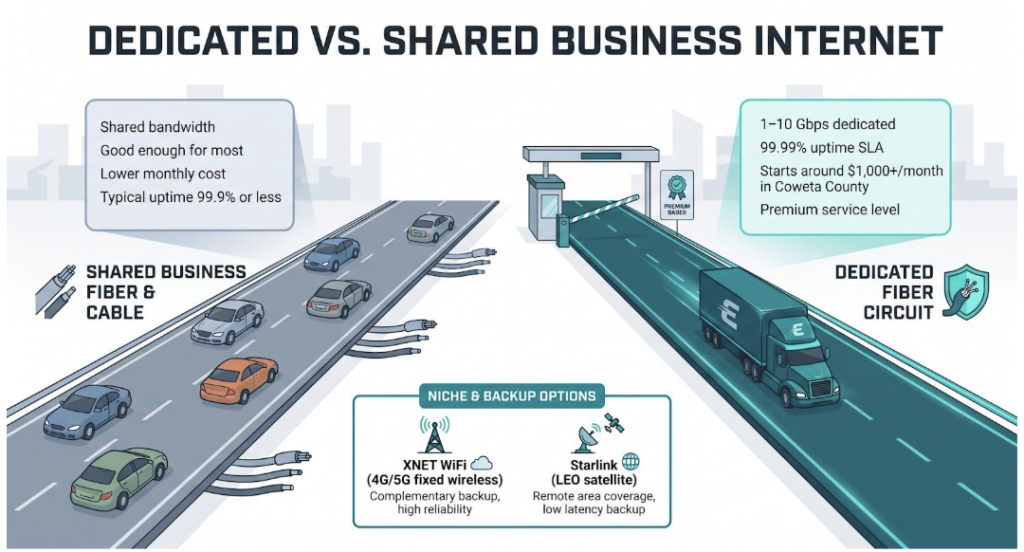
Think of it as a personal tollway. AT&T, Comcast Enterprise, Spectrum Enterprise, Windstream, and several carrier-neutral wholesalers will pull a strand straight to your suite, light it at 1, 2, or 10 Gbps, and back it with a 99.99 percent uptime service-level agreement. Four-hour mean-time-to-repair clauses, 24 × 7 monitoring, and proactive truck rolls are baked into the fee.
That fee is steep. A dedicated 1 Gbps circuit in Coweta County starts near $1,000 per month, roughly ten times the price of shared business fiber. Installation can stretch to 90 days while crews secure permits and splice glass. For many small firms the math fails, but if every minute offline costs four figures, the premium brings peace of mind.
Beyond fiber, a few specialty players round out the landscape. XNET WiFi sells fixed-wireless links that use multi-carrier 4G and 5G vSIM technology, reaching up to 2 Gbps with plug-and-play installs finished in minutes. Starlink covers all of Newnan with low-earth-orbit satellite providing 150 to 200 Mbps down and 20 Mbps up. It is not gigabit, yet for rural outposts or third-line failover, it beats legacy geosynchronous dishes.
Bottom line: if your workflow cannot tolerate the unpredictability of shared networks, or if geography leaves you outside the cable and fiber grid, these niche options keep you online at a premium.
Scorecard: who wins on speed, value, and support
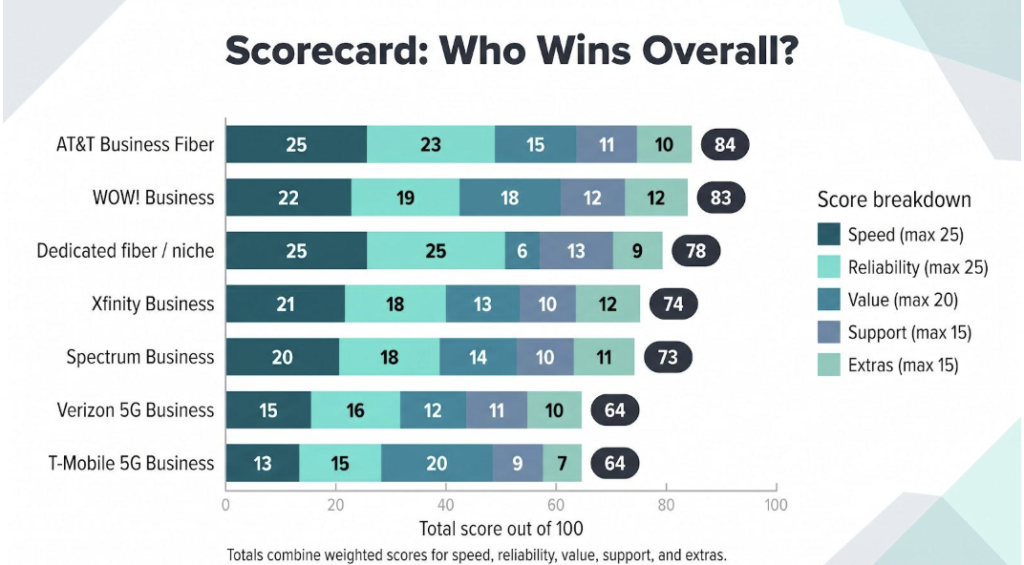
We ran each provider through the five-pillar rubric outlined earlier. A perfect 100 marks flawless performance across the board, while anything in the 60s flags trade-offs you’ll notice in daily use.
| Provider | Speed (25) | Reliability (25) | Value (20) | Support (15) | Extras (15) | Total |
| AT&T Business Fiber | 25 | 23 | 15 | 11 | 10 | 84 |
| WOW! Business | 22 | 19 | 18 | 12 | 12 | 83 |
| Xfinity Business | 21 | 18 | 13 | 10 | 12 | 74 |
| Spectrum Business | 20 | 18 | 14 | 10 | 11 | 73 |
| Dedicated fiber / niche | 25 | 25 | 6 | 13 | 9 | 78 |
| Verizon 5G Business | 15 | 16 | 12 | 11 | 10 | 64 |
| T-Mobile 5G Business | 13 | 15 | 20 | 9 | 7 | 64 |
Key takeaways:
- AT&T edges into first place thanks to symmetrical multi-gig speed and a tighter uptime goal, but WOW! trails by only one point because of its aggressive pricing and local support.
- T-Mobile posts the lowest raw performance, yet its low monthly cost lifts its overall score to match Verizon. Price can outweigh pure horsepower when budgets are strict.
- Dedicated fiber earns perfect marks for speed and reliability but plunges on value. If minutes of downtime carry four-figure losses, the premium makes sense; otherwise shared fiber or cable wins the budget fight.
Use these totals as a compass, not a rulebook. If upload speed tops your priority list, boost AT&T. If contract freedom matters most, lean toward Spectrum. Match the provider to the pain point you refuse to tolerate.
FAQ: your top internet questions, answered
How do I check which providers serve my exact address?
Enter your street number in each provider’s availability tool, then confirm on the FCC Broadband Map. If one site shows “not available,” try another. Five minutes of checks can reveal hidden fiber options.
Do I need a business-class plan?
Yes. Business tiers include faster support queues, optional static IPs, and terms that permit commercial traffic. Residential service often bars public Wi-Fi or heavy uploads and leaves you last in line during an outage.
Which provider is the fastest right now?
AT&T offers up to 5 Gbps fiber today. Comcast may match that as DOCSIS 4.0 reaches Newnan, but for symmetrical multi-gig service now, fiber leads.
Is gigabit overkill for a five-person office?
Not usually. The price gap between 300 Mbps and 1 Gbps keeps shrinking. An extra $20 per month buys headroom for cloud backups and video displays you may add next quarter.
Can I get a static IP?
WOW!, Spectrum, Comcast, and AT&T all sell static IPv4 addresses for a modest monthly fee. Verizon includes one on select 5G Business tiers. T-Mobile does not, so plan on dynamic DNS or a VPN workaround.
What if I need near-zero downtime?
Combine links. Many retailers pair AT&T Fiber with a T-Mobile or Verizon 5G gateway for failover. A dual-WAN router switches traffic automatically and often costs less than one lost sale.
How long does installation take?
Cable or wireless setups finish in a few days. Fiber is often live, but pulling new glass can take one to two weeks. Dedicated fiber builds run 60–90 days.
Conclusion
Newnan is one of the rare markets where small businesses get real choice. WOW! Business is the local-value front-runner, AT&T Business Fiber wins on symmetrical speed and uptime, and Spectrum Business is the pick when you want no contract. Xfinity Business future-proofs heavy upgrade paths, while T-Mobile and Verizon 5G make strong budget backups or quick-start lines. Map the winner to what your operation actually needs — speed, price, or redundancy — then request quotes from two providers so you have leverage. Bookmark this guide so you can revisit key specs when you request quotes.