


Somewhere in your ad account is a campaign that looks like a star on paper. Then you look a little closer, and most of those customers bought one discounted product and never returned. A few months later, your business can barely tell they were ever there.
That’s the problem with treating Return on Ad Spend (ROAS) as the finish line instead of one piece of the story. ROAS tells you how much revenue your ads generated for every dollar you spent. What it can’t tell you is whether those customers made repeat purchases, let alone tell a friend about you.
Customer Lifetime Value (CLV) fills in those blanks. It shifts your attention from the first transaction to the entire customer relationship. Once you start measuring success that way, decisions about ad spend, customer acquisition, and even discounts change.
ROAS remains a solid metric for how efficiently your campaigns buy customers. But CLV tells you whether you’re buying the right customers. And together, they paint a much clearer picture of long-term growth. Here’s why CLV deserves a bigger role in how you measure marketing success.
ROAS Is the First Chapter, Not the Whole Story
ROAS is one of the most useful metrics in advertising because it answers a simple question: “Did this campaign generate enough revenue for what we spent?”
ROAS is a great way to judge campaign performance in the short term. The problem starts when it becomes the only number guiding your decisions. CLV, on the other hand, estimates how much a customer is worth across their entire relationship with your brand.
Mathematically, ROAS is calculated as:
ROAS = Revenue Generated from AdsAd Spend X 100
Say you’re running two campaigns. Campaign A pulls a 6x ROAS, but most of those buyers are bargain hunters chasing discounts. Campaign B pulls 3x ROAS, but those customers keep coming back to buy new products at full price and recommend your brand to friends.
Six months later, Campaign B has pulled ahead in total profit, even though its opening numbers looked worse on paper.
This is why experienced marketers look beyond the first purchase. A performance-driven DTC ecommerce agency evaluates the entire customer journey because profitable growth depends on more than getting someone through checkout once.
Once you start measuring customers instead of transactions, your marketing decisions evolve significantly for the better.
Customer Lifetime Value Changes How You Spend
Customer lifetime value estimates how much revenue a customer is likely to generate throughout their relationship with your business. That single shift changes how you think about marketing.
Mathematically, CLV is calculated as:
CLV= Average Purchase Value X Purchase Frequency X Customer Lifespan
If the average customer spends $100 once, paying $60 to acquire them leaves very little room for profit. But what if that same customer typically returns four more times over the next two years and spends $500 in total? Suddenly, that $60 acquisition cost looks much more reasonable.
This is why CLV matters when setting advertising budgets. Businesses that understand customers’ value over time can often afford to spend more to acquire them. Competitors focused on ROAS, however, pull back too early because they don’t see the bigger picture.
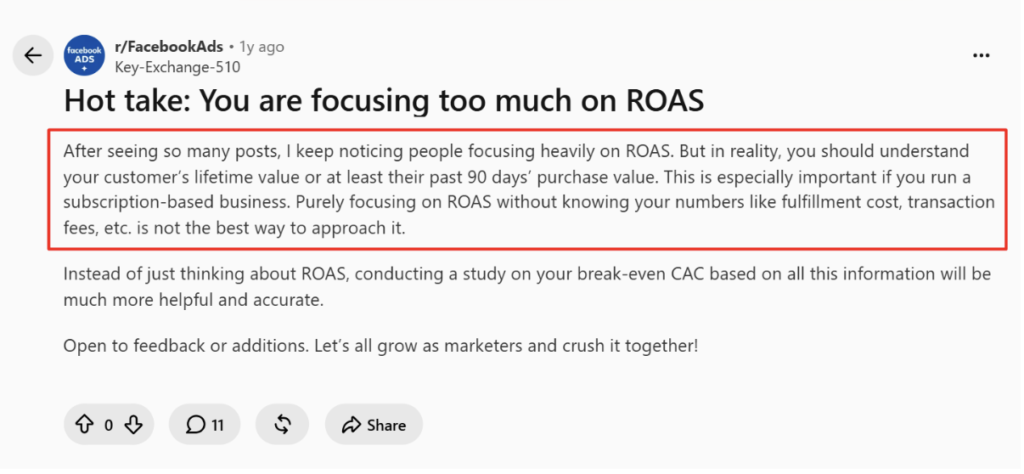
Source: Reddit
CLV also rewards something ROAS cannot fully capture: customer relationships. Repeat purchases, subscriptions, renewals, upgrades, and referrals all increase a customer’s value long after the first transaction.
Various studies have also found that acquiring a new customer costs far more than retaining an existing one, with many estimating it costs 5 to 7 times as much. Shopify’s benchmarks put the ideal ratio at roughly $3 in lifetime revenue for every $1 spent acquiring a customer.
Businesses that keep existing customers happy spend less time replacing lost buyers and more time growing the value of the customers they already have.
High ROAS Can Hide Expensive Problems
A healthy ROAS does not automatically mean a healthy business. Discounts are a good example. A deep promotion can drive impressive ROAS because it attracts plenty of buyers.
But if those discounts shrink your margins and attract customers who only purchase when prices are slashed, your campaign may look far better than your bottom line.
The same thing happens when one-time buyers inflate campaign performance. Revenue rises in the short term, yet repeat purchase rates remain flat. Customer acquisition costs stay high because every month starts with finding another wave of new customers.
Optimizing only for ROAS can also push marketers toward decisions that hurt long-term growth. You may reduce acquisition costs today while overlooking opportunities to attract customers who would have been far more valuable over time.
Case in point, recent DTC benchmarks show repeat customers generate 3 to 4 times the ROAS of first-time buyers, which is exactly the signal a single-campaign snapshot misses. ROAS tells you whether your advertising is efficient, not whether your customer acquisition strategy is sustainable.

The Best Marketing Teams Measure Both CLV and ROAS
Every high-performing marketing team uses both ROAS and CLV because each answers a different question. ROAS helps you understand how campaigns are performing right now. It tells you which ads and offers are generating revenue efficiently.
CLV provides the context behind those numbers. It helps you decide how much you can spend to acquire customers, where to invest your budget, and which audiences are most valuable to your business over time.
When you look at both metrics together, your decisions become more confident. You stop optimizing for the cheapest customer and start investing in the customers who create the most value.